
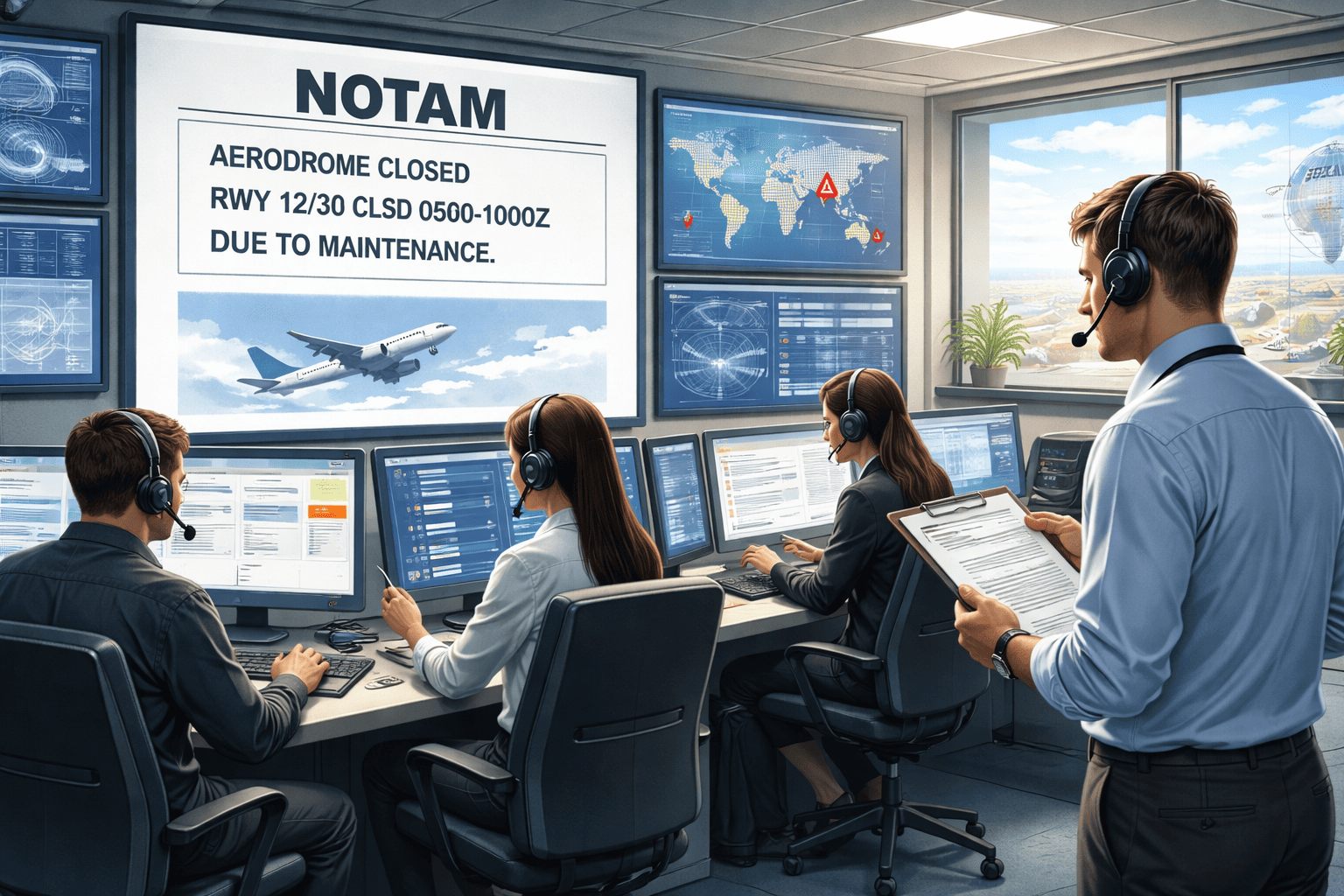
The NOTAM System: A Global Network
Every day, thousands of NOTAMs are issued around the world, informing pilots of everything from routine runway maintenance to emergency airspace closures. But who actually creates these critical aviation notices? The answer reveals a complex, interconnected global system involving hundreds of organizations, from local airport managers to international aviation authorities.
Understanding who issues NOTAMs—and why they have that authority—helps pilots evaluate the credibility and importance of the information they're reading. It also reveals how the aviation safety system functions at both local and global levels.
🌍 Global Scale: Over 190 countries issue NOTAMs through their civil aviation authorities. These NOTAMs are distributed through ICAO's International NOTAM Office, creating a worldwide network that processes over 1 million NOTAMs annually.
The Primary Issuers: Civil Aviation Authorities
National Aviation Authorities
In every country, a national civil aviation authority holds primary responsibility for issuing NOTAMs within their sovereign airspace. These are the top-level organizations that oversee all aviation safety and operations.
United States: Federal Aviation Administration (FAA)
Responsibilities:
- All NOTAMs for U.S. airports and airspace
- FDC NOTAMs (regulatory and procedural changes)
- Temporary Flight Restrictions (TFRs)
- Military NOTAMs coordination with DoD
- International NOTAMs for U.S. territories
Structure: The FAA operates through regional offices and the Flight Data Center. They process approximately 200,000 NOTAMs annually for the U.S. National Airspace System.
Europe: National Aviation Authorities + EASA
European NOTAMs involve both national authorities and the European Union Aviation Safety Agency (EASA):
- UK: Civil Aviation Authority (CAA)
- France: Direction Générale de l'Aviation Civile (DGAC)
- Germany: Luftfahrt-Bundesamt (LBA)
- Spain: Agencia Estatal de Seguridad Aérea (AESA)
Each country's CAA issues NOTAMs for their airspace, while EASA coordinates safety-related notices affecting multiple countries.
Other Major Authorities
- Canada: Transport Canada (TC)
- Australia: Civil Aviation Safety Authority (CASA)
- Japan: Civil Aviation Bureau (JCAB)
- India: Directorate General of Civil Aviation (DGCA)
- Brazil: Agência Nacional de Aviação Civil (ANAC)
- China: Civil Aviation Administration of China (CAAC)
The Authorization Chain
While national authorities have ultimate responsibility, they delegate NOTAM issuance authority to various entities:
- National CAA → Sets policy and oversees system
- Regional Offices → Manage geographic areas
- Air Traffic Services → Issue operational NOTAMs
- Airport Authorities → Report facility changes
- Certified Organizations → Submit NOTAM requests
Who Can Request or Issue NOTAMs?
Direct Issuers (With Authority)
These organizations can issue NOTAMs directly into the system:
1. Air Traffic Control Centers
Authority for:
- Navigation aid status changes
- Airspace restrictions
- Communication frequency changes
- Radar service availability
- Emergency airspace closures
Example: When New York Center (KZNY) detects a VOR failure, the center can immediately issue a NOTAM without waiting for higher approval.
2. Airport Operators
Authority for:
- Runway closures and conditions
- Taxiway status
- Lighting system outages
- Construction activities
- Fuel availability
- Service restrictions
Process: Large airports often have NOTAM offices staffed 24/7. They enter NOTAMs directly into their national system, which then distributes internationally if needed.
3. Flight Service Stations
Authority for:
- Local airport NOTAMs at uncontrolled fields
- Weather-related operational restrictions
- Pilot reports requiring NOTAM action
- Coordination of military activity NOTAMs
Role: Flight Service acts as intermediary between small airports/pilots and the NOTAM system, verifying information and formatting notices correctly.
Indirect Issuers (Request Through Authority)
These entities cannot issue NOTAMs directly but can request them:
1. Airport Fixed-Based Operators (FBOs)
FBOs report changes affecting their services:
- Fuel unavailability
- Hangar space limitations
- Service hour changes
- Ground equipment outages
Process: FBO → Airport Authority → NOTAM issued
2. Military Commands
Military organizations coordinate through civil aviation authorities:
- Military exercise areas
- Temporary flight restrictions for operations
- Missile test ranges
- GPS interference testing
Process: Military Command → CAA Coordination Office → NOTAM issued
3. Construction Companies
When building near airports or in airspace:
- Cranes exceeding height limits
- Construction affecting airport property
- Obstacles in approach paths
Process: Company applies for permit → CAA approves → NOTAM issued
4. Event Organizers
Large events may trigger NOTAMs:
- Sporting events requiring TFRs
- Air shows and demonstrations
- Fireworks displays
- Drone light shows
Process: Organizer requests → CAA evaluates → NOTAM issued if approved
5. Pilots and Operators
Pilots can trigger NOTAM issuance:
- Reporting unlighted obstacles
- Identifying navigation aid issues
- Noting runway condition problems
- Reporting wildlife hazards
Process: Pilot report → ATC or Flight Service → Verification → NOTAM issued
The NOTAM Creation Process
Step 1: Identification of Condition
Someone identifies a condition requiring a NOTAM:
- Airport maintenance crew discovers runway light failure
- ATC detects navigation aid degradation
- Military schedules exercise in civilian airspace
- Pilot reports new obstacle
Step 2: Information Verification
The responsible authority verifies the information:
- Technical verification: Is the equipment actually unserviceable?
- Geographic verification: Exact location and affected area
- Timing verification: Start and end times
- Impact assessment: Who needs to know?
Step 3: NOTAM Drafting
Authorized personnel create the NOTAM:
- Select appropriate ICAO format and codes
- Determine affected area and altitude
- Calculate Q-line parameters
- Write clear E) field description
- Assign proper classification
Step 4: Quality Control
Before distribution, NOTAMs undergo review:
- Format check: Does it follow ICAO standards?
- Accuracy check: Are coordinates and times correct?
- Duplication check: Does a NOTAM already exist for this?
- Classification check: Is priority level appropriate?
Step 5: Distribution
The NOTAM enters the distribution network:
- National system: Posted to country's NOTAM database
- International distribution: Sent to ICAO International NOTAM Office
- Regional dissemination: Distributed to affected countries
- User access: Available through briefing systems, apps, and websites
The International NOTAM Office (INO)
ICAO's Central Hub
The International Civil Aviation Organization (ICAO) operates the International NOTAM Office, which serves as the global distribution hub for NOTAMs.
Functions:
- Receives NOTAMs from all ICAO member states
- Validates format and coding
- Distributes to relevant countries and regions
- Maintains historical NOTAM database
- Coordinates international NOTAM standards
How International Distribution Works
- Origin: U.S. airport issues runway closure NOTAM
- National system: Enters FAA NOTAM database
- International gateway: FAA sends to INO if affects international traffic
- Distribution: INO forwards to countries with airlines serving that airport
- Access: Foreign airlines retrieve through their national systems
Specialized NOTAM Issuers
Meteorological Authorities
Weather services issue specialized NOTAMs:
Volcanic Ash Advisory Centers (VAACs)
- Issue ASHTAMs for volcanic eruptions
- 9 VAACs worldwide monitor volcanic activity
- Coordinate with aviation authorities
- Provide ash cloud forecasts
Meteorological Watch Offices (MWOs)
- Issue weather-related operational NOTAMs
- Coordinate with ATC for weather impacts
- Monitor severe weather affecting aviation
Space Agencies
Space operations trigger specialized NOTAMs:
- NASA: U.S. space launches and reentries
- ESA: European space operations
- Roscosmos: Russian space activities
- CNSA: Chinese space program
Coordination: Space agencies work with CAAs to issue NOTAMs for launch windows, reentry corridors, and debris hazard areas.
Security and Law Enforcement
Various security agencies can trigger NOTAM issuance:
Presidential and VIP Protection
- U.S. Secret Service: Coordinates TFRs for Presidential movements
- Foreign protection services: Similar for heads of state
Emergency Management
- Natural disasters (hurricanes, wildfires)
- Search and rescue operations
- Emergency response requiring airspace closure
Quality Control and Oversight
Who Ensures Accuracy?
Multiple layers of oversight maintain NOTAM quality:
Internal Review
- Issuing authority's quality assurance
- Automated format validation
- Supervisor approval for critical NOTAMs
External Oversight
- National CAA audits of NOTAM procedures
- ICAO compliance monitoring
- Industry feedback mechanisms
- Safety investigation reviews
Error Correction Process
When errors occur:
- Detection: Error identified by user or automated system
- Verification: Issuing authority confirms error
- Correction: NOTAMR issued to replace incorrect NOTAM
- Distribution: Corrected NOTAM distributed immediately
- Review: Process reviewed to prevent recurrence
Technology and Automation
Modern NOTAM Systems
Technology has transformed NOTAM issuance:
Automated Systems
- NAIMES: U.S. Federal NOTAM System
- EAD: European AIS Database
- SWIM: System Wide Information Management
These systems:
- Validate format automatically
- Check for duplicates
- Calculate geographic parameters
- Manage distribution lists
- Handle automatic expiration
Future: Digital NOTAMs
ICAO is transitioning to Digital NOTAM (D-NOTAM):
- Machine-readable format
- Direct integration with flight management systems
- Automated relevance filtering
- Real-time updates
- Reduced human error
Accountability and Liability
Who Is Responsible?
Clear lines of responsibility exist:
Issuing Authority
- Responsible for accuracy of information
- Must verify before issuance
- Liable for errors causing incidents
- Must correct mistakes promptly
Information Providers
- Airports must report facility changes accurately
- ATC must verify technical failures
- Contractors must report construction correctly
Users (Pilots and Operators)
- Responsible for checking applicable NOTAMs
- Must interpret NOTAMs correctly
- Cannot claim ignorance of published NOTAMs
Legal Framework
NOTAM issuance operates within legal frameworks:
- International: ICAO Annexes and Standards
- National: Aviation regulations and airspace rules
- Liability: Negligence standards for errors
- Enforcement: Violations can result in penalties
How to Verify NOTAM Sources
Checking Authenticity
How to ensure a NOTAM is legitimate:
- Check NOTAM number format: Should match issuing authority's standard
- Verify through official sources: Cross-reference with CAA website
- Confirm issuing authority: Does it make sense for this organization to issue this NOTAM?
- Look for official distribution: Is it in multiple official databases?
Reporting Issues
If you suspect a problem with a NOTAM:
- Contact the issuing authority directly
- Provide specific NOTAM number
- Explain the concern clearly
- Follow up to ensure resolution
Conclusion: A Global Collaboration
The NOTAM system represents one of aviation's greatest collaborative achievements. From local airport managers to international organizations, from pilots reporting hazards to air traffic controllers issuing urgent notices, thousands of professionals work together to keep the global aviation system informed and safe.
Understanding who issues NOTAMs—and the complex network behind each notice—helps pilots appreciate the system's depth and reliability. Every NOTAM you read has been verified, formatted, and distributed through a sophisticated network designed to get critical information to those who need it, when they need it.
The next time you check NOTAMs before a flight, remember: behind each notice is an authorized professional who verified that information, an organization that approved its release, and a global network that delivered it to your screen. That's the NOTAM system at work.
Access the Global NOTAM Network
NOTAM Viewer connects you to NOTAMs issued by aviation authorities worldwide. Search any airport or FIR to see official notices from their responsible CAAs.