
Understanding NOTAM Classifications
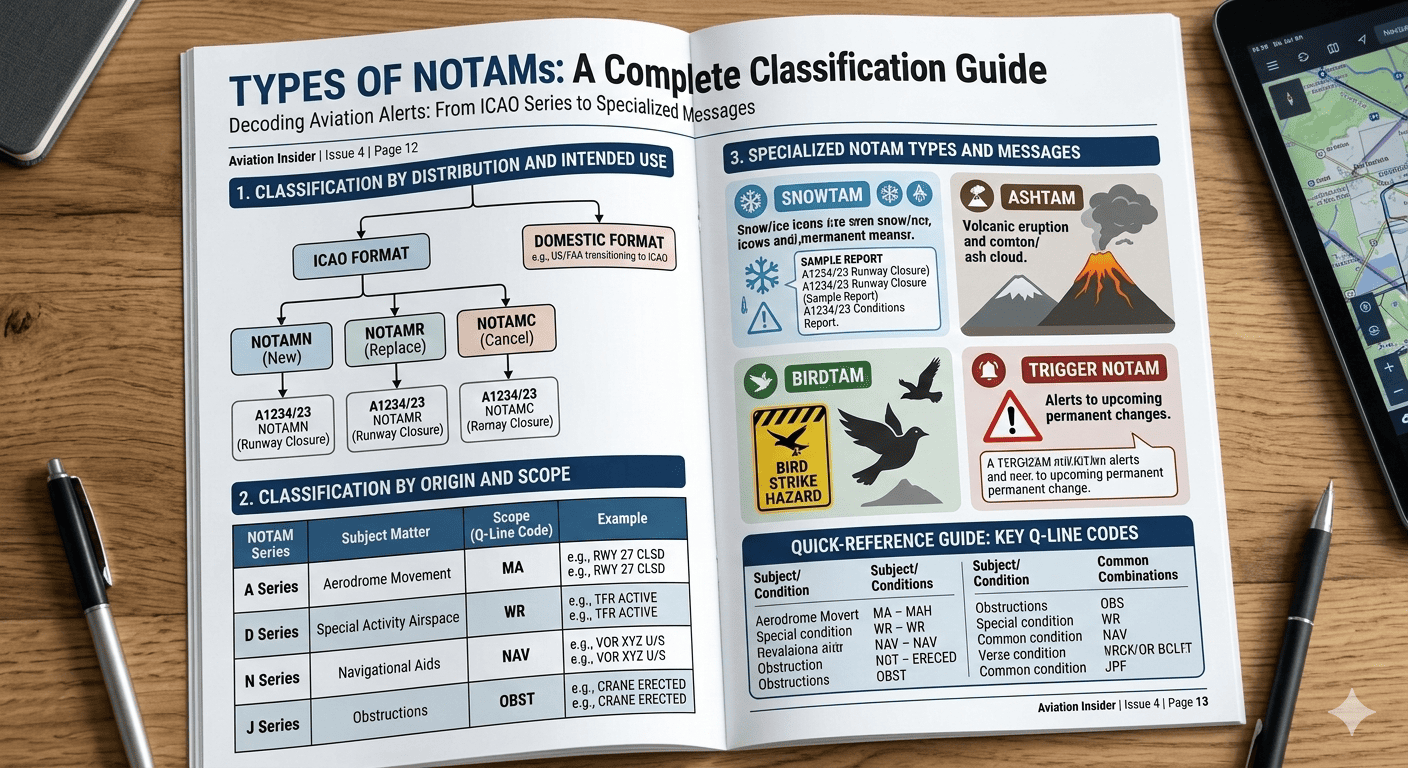
Not all NOTAMs are created equal. The aviation industry uses different types and classifications of NOTAMs to communicate different kinds of information. Understanding these classifications helps pilots quickly identify the most relevant information and prioritize which NOTAMs require immediate attention versus those that are merely informational.
This comprehensive guide covers all major NOTAM types, from standard NOTAMs to specialized formats like SNOWTAMs and ASHTAMs, explaining when each is used and how to interpret them effectively.
🎯 Quick Reference: The most common NOTAM types you'll encounter are: NOTAM (new), NOTAMR (replace), NOTAMC (cancel), and FDC NOTAMs (regulatory). Special types like SNOWTAM and ASHTAM are used for specific conditions.
Standard NOTAM Types
1. NOTAM (New NOTAM)
The standard NOTAM represents new information that pilots need to know. When people say "NOTAM," they're usually referring to this type.
Format Example:
Q) KZNY/QMRLC/IV/NBO/A/000/999/4038N07346W005
A) KJFK
B) 2602271200
C) 2602281200
E) RWY 04L/22R CLSD FOR MAINTENANCE
Characteristics:
- Introduces new information not previously published
- Begins with an exclamation point (!)
- Has a unique NOTAM number (e.g., 02/045)
- Remains active until the expiry time or until canceled
When Used:
- Runway closures
- Navigation aid outages
- New obstacles
- Lighting system failures
- Changes to procedures
- Any new condition affecting operations
2. NOTAMR (Replace NOTAM)
A NOTAMR replaces an existing NOTAM, superseding all information in the original.
Format Example:
Q) KZNY/QMRLC/IV/NBO/A/000/999/4038N07346W005
A) KJFK
B) 2602271200
C) 2602291200
E) RWY 04L/22R CLSD FOR MAINTENANCE
EXTENDED TO 29 FEB DUE TO WEATHER DELAYS
Key Points:
- Completely replaces the referenced NOTAM
- Original NOTAM is no longer valid
- Usually issued to extend time, modify details, or correct errors
- Gets a new NOTAM number
- References the replaced NOTAM number
Common Reasons for NOTAMR:
- Extending closure duration
- Shortening closure duration
- Correcting errors in original NOTAM
- Adding additional information
- Modifying affected areas or altitudes
3. NOTAMC (Cancel NOTAM)
A NOTAMC cancels an existing NOTAM before its scheduled expiry time.
Format Example:
Q) KZNY/QMRLC/IV/NBO/A/000/999/4038N07346W005
A) KJFK
B) 2602271800
E) NOTAM 02/045 CANCELLED - RWY 04L/22R NOW OPERATIONAL
Characteristics:
- Immediately terminates the referenced NOTAM
- Very brief - only needs to identify what's being canceled
- Effective immediately upon issue
- No C) field needed (cancellation is immediate)
When Issued:
- Facility returns to service early
- Work completed ahead of schedule
- Original NOTAM issued in error
- Situation resolves unexpectedly
Specialized NOTAM Types
4. FDC NOTAM (Flight Data Center)
FDC NOTAMs are regulatory in nature and issued by the FAA's Flight Data Center in the United States. Other countries have equivalent regulatory NOTAM systems.
Format Example:
ILS OR LOC RWY 4L, AMDT 7B...
LNAV/VNAV DA 231/HAT 211 ALL CATS.
LNAV MDA 340/HAT 320 ALL CATS.
TEMPORARY CRANE 385 FT AGL 1400FT SW OF RWY 4L (2021-AEA-2584-NRA).
Types of FDC NOTAMs:
Temporary Flight Restrictions (TFRs)
- Presidential movements
- Major sporting events
- Emergency situations
- Natural disasters
- Space operations
- Wildfire TFRs
Instrument Approach Procedure Changes
- Temporary changes to approach minimums
- Navigation aid changes affecting approaches
- Obstacle issues
- NOTAM radar outages
Airspace Changes
- Temporary airspace modifications
- Special use airspace activations
- Laser operations
- Rocket launches
Critical Importance: FDC NOTAMs are regulatory - you must comply with them. Violations can result in certificate actions.
5. SNOWTAM
SNOWTAMs provide detailed information about runway contamination from snow, ice, slush, or water.
Format Example:
A) ESSA B) 02271200 C) 04L
D) 100/100/100 E) COMPACTED SNOW
F) 05/05/05 G) 20/20/20
H) GOOD/GOOD/GOOD T) -8C
SNOWTAM Fields Explained:
- A: Location (airport identifier)
- B: Date/time of observation
- C: Runway designator
- D: Percentage of contamination (beginning/middle/end)
- E: Type of contamination (ice, snow, slush, water)
- F: Depth of contamination in mm
- G: Width affected in meters from centreline
- H: Braking action (GOOD, MEDIUM, POOR)
- T: Temperature
Why SNOWTAMs Are Critical:
- Affects takeoff and landing performance calculations
- Required for determining if operations are safe
- Braking action information crucial for stopping distance
- Temperature affects contamination type
Contamination Types:
- DRY SNOW: Loose, powdery
- WET SNOW: Moisture content high
- COMPACTED SNOW: Compressed into solid mass
- SLUSH: Water-saturated snow
- ICE: Frozen water on surface
- STANDING WATER: Liquid water pools
6. ASHTAM (Volcanic Ash NOTAM)
ASHTAMs provide critical information about volcanic ash clouds that pose extreme danger to aircraft.
Format Example:
DTG: 20260227/1200Z
VOLCANO: EYJAFJALLAJOKULL 1702
PSN: N6338 W01939
AREA: ICELAND
SUMMIT ELEV: 5417 FT (1651 M)
ADVISORY NR: 2026/45
INFO SOURCE: ICELANDIC MET OFFICE
ERUPTION DETAILS: CONTINUOUS EMISSIONS
OBS VA DTG: 27/1200Z
OBS VA CLD: SFC/FL350 N6320 W01920 - N6330 W01900
FCST VA CLD +6HR: FL180/FL400 N6300 W01800
RMK: ASH CLOUD DRIFTING EAST AT 40KT
Key ASHTAM Elements:
- Volcano identification: Name and number
- Position: Exact coordinates
- Eruption status: Active, continuous, intermittent
- Ash cloud location: Current and forecast positions
- Altitude: Vertical extent of ash cloud
- Movement: Direction and speed of drift
Why ASHTAMs Are Critical:
- Volcanic ash can cause complete engine failure
- Damages aircraft windscreens and sensors
- Can't be detected by weather radar
- May be invisible in clouds or at night
- Requires immediate avoidance
7. Special NOTAMs
Pointer NOTAMs
Direct users to look at another source for information:
Used when detailed information is published elsewhere to avoid duplication.
Military NOTAMs
Published by military authorities for military aerodromes and operations:
- May use different format
- May not be available in civilian systems
- Often contain classified or restricted information
- PPR (Prior Permission Required) common
International NOTAMs
Follow ICAO standards but may have regional variations:
- European NOTAMs often more detailed
- Some countries include additional information
- Language may be English, local language, or both
- Format variations based on regional requirements
NOTAM Classes by Priority
Class I - Essential Information
Information that could affect the decision to conduct a flight:
- Aerodrome closures
- Runway closures at destination/alternate
- Complete navigation aid outages
- Airspace closures
- Fuel unavailability
Action Required: Must be reviewed before flight planning.
Class II - Important Information
Information affecting flight planning but not necessarily go/no-go:
- Taxiway closures
- Partial runway closures
- Lighting outages
- Navigation aid reduced power
- Frequency changes
Action Required: Should be reviewed during detailed flight planning.
Class III - Supplementary Information
Information useful but not critical to flight safety:
- Facility phone number changes
- Construction not affecting operations
- Personnel changes
- Notice of future changes
Action Required: Review if time permits, good to know.
NOTAM Scope Classifications
Checklist NOTAMs (K)
Provided as summary information for briefing purposes:
- Condensed list of NOTAMs
- Does not replace full NOTAM review
- Used for quick overview
- Must verify details in full NOTAMs
Trigger NOTAMs
Automatically activate other NOTAMs when conditions are met:
- Weather-dependent (e.g., "When visibility <3 miles")
- Time-dependent
- Condition-dependent
Outlook NOTAMs
Advance notice of planned future events:
- Usually 2-4 weeks in advance
- Subject to change
- Helps long-term planning
- Should verify closer to date
NOTAM Series by Geographic Scope
Domestic NOTAMs
Apply within a single country's airspace:
- Standard format for that country
- Filed in national NOTAM system
- May not appear in international databases
International NOTAMs
Disseminated internationally through ICAO system:
- Follow ICAO standard format
- Available in international databases
- Required for facilities serving international traffic
Oceanic NOTAMs
Apply to oceanic control areas:
- Often cover vast areas
- Critical for transoceanic flights
- May include satellite communication info
How to Use Different NOTAM Types in Flight Planning
Step 1: Check Standard NOTAMs
- Review all active NOTAMs for route
- Look for NOTAMR references to ensure you have latest version
- Note any NOTAMC cancellations
- Identify Class I (essential) items first
Step 2: Review FDC NOTAMs
- Check for TFRs along route
- Verify approach procedure NOTAMs for destination
- Note any airspace changes
- These are regulatory - must comply
Step 3: Check Specialized NOTAMs
- Winter operations: Look for SNOWTAMs
- Volcanic regions: Check for ASHTAMs
- Special events: Review any pointer NOTAMs
Step 4: Organize by Priority
- Class I items → Document and brief
- Class II items → Note and plan for
- Class III items → Acknowledge if relevant
Common Mistakes with NOTAM Types
1. Using Superseded NOTAMs
The Error: Not realizing a NOTAM has been replaced or canceled.
How to Avoid:
- Always check for NOTAMR and NOTAMC
- Use system that automatically shows only current NOTAMs
- Recheck before departure
2. Ignoring FDC NOTAMs
The Error: Focusing only on standard NOTAMs and missing regulatory FDC NOTAMs.
How to Avoid:
- Always check FDC NOTAM section separately
- Treat FDC NOTAMs as highest priority
- Brief crew specifically on FDC items
3. Misinterpreting SNOWTAMs
The Error: Not understanding SNOWTAM format and making incorrect performance calculations.
How to Avoid:
- Learn SNOWTAM format thoroughly
- Use aircraft performance manual's contaminated runway tables
- When in doubt, call the airport for clarification
Conclusion
Understanding the different types of NOTAMs and their classifications is essential for efficient flight planning and safe operations. Each NOTAM type serves a specific purpose, from the standard NOTAM introducing new information to specialized formats like SNOWTAMs and ASHTAMs that address specific hazardous conditions.
By recognizing the difference between NOTAM, NOTAMR, and NOTAMC, you ensure you're always working with current information. By understanding FDC NOTAMs, you know which NOTAMs are regulatory requirements versus advisory information. And by learning specialized formats like SNOWTAMs, you can properly assess winter operational hazards.
Make it a habit to check all NOTAM types relevant to your flight, not just the most obvious ones. Your thoroughness in reviewing different NOTAM categories directly translates to safer, more informed flight operations.
Search All NOTAM Types
NOTAM Viewer automatically presents all types of NOTAMs for any location, including standard NOTAMs, FDC NOTAMs, and specialized formats. Get the complete picture in one search!