The Critical Role of NOTAMs in Conflict Zones
NOTAMs serve as the aviation industry's primary warning system for dangerous conditions, and nowhere is this more critical than in areas affected by military conflicts. From full-scale wars to regional tensions, military operations create some of the most hazardous conditions for civilian aviation, and NOTAMs are often the only formal notice pilots receive about these dangers.
Understanding how to identify, interpret, and respond to conflict-related NOTAMs is essential for any pilot operating internationally or near regions with military activity. This guide covers everything you need to know about NOTAMs in military conflict zones, from identification to risk assessment to decision-making.
⚠️ Critical Safety Notice: Military conflict zones represent extreme hazards to civilian aviation. NOTAMs may be your only warning before entering dangerous airspace. This article provides educational information only and should not be your sole source for operational decisions in or near conflict areas.
Historical Context: When NOTAMs Failed to Prevent Tragedy
The importance of conflict-related NOTAMs became tragically clear through several high-profile incidents involving civilian aircraft in war zones:
Malaysia Airlines Flight MH17 (2014)
On July 17, 2014, Malaysia Airlines Flight 17 was shot down over eastern Ukraine while en route from Amsterdam to Kuala Lumpur, killing all 298 people aboard. The aircraft was struck by a surface-to-air missile at an altitude of 33,000 feet.
NOTAM Issues:
- Ukrainian NOTAMs restricted airspace only below 32,000 feet
- Many airlines continued routing flights over the conflict zone at higher altitudes
- Intelligence about advanced surface-to-air missile systems was not reflected in NOTAMs
- No coordinated international NOTAM warning about the specific threat
Lessons Learned: NOTAMs may not adequately reflect the true threat level in conflict zones. Airlines must conduct independent risk assessments beyond published NOTAMs.
Ukraine International Airlines Flight PS752 (2020)
On January 8, 2020, Ukraine International Airlines Flight 752 was shot down shortly after takeoff from Tehran, Iran, killing all 176 people aboard. The aircraft was struck by Iranian surface-to-air missiles during a period of heightened military tension.
NOTAM Issues:
- Iranian airspace remained open to civilian traffic despite military operations
- No NOTAM warned of active missile defense systems
- Short timeframe between military escalation and the incident
- Normal civilian operations continued in a high-threat environment
Lessons Learned: Rapid escalation of military tensions may not be immediately reflected in NOTAMs. Airspace can transition from safe to dangerous in hours.
Korean Air Lines Flight 007 (1983)
While predating modern NOTAM systems, the 1983 shootdown of KAL 007 over Soviet airspace demonstrated how military tensions can create lethal hazards for civilian aviation. The incident led to significant improvements in how military activity is communicated to civilian operators.
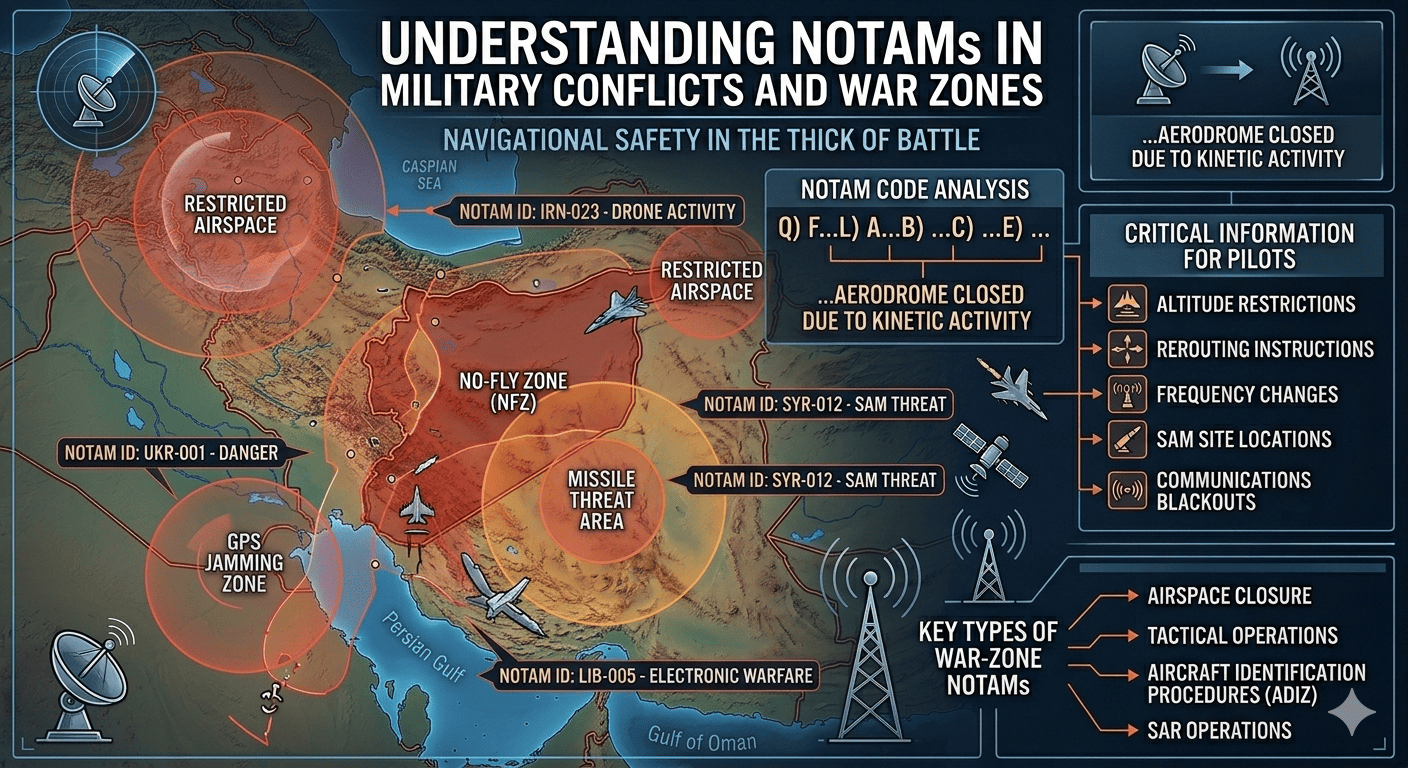
Types of Conflict-Related NOTAMs
1. Airspace Closures
The most severe conflict-related NOTAMs involve complete airspace closures:
Total FIR Closure:
- Entire Flight Information Region closed to civilian traffic
- Usually indicates active warfare or extreme danger
- Example: Syrian airspace (various periods), portions of Ukrainian FIR (2022-present)
- Violations can result in aircraft being shot down
Partial Airspace Restrictions:
- Specific regions or altitudes restricted
- May allow overflights at higher altitudes
- Often includes buffer zones around conflict areas
- Can change rapidly as conflict evolves
2. Altitude Restrictions
Some conflict zones allow overflights above certain altitudes:
Typical Patterns:
- Below FL260: Closed (shoulder-fired missiles, short-range systems)
- Below FL320: Closed (medium-range surface-to-air missiles)
- Above FL400: Sometimes permitted (beyond most ground-based threats)
Warning: As MH17 demonstrated, altitude restrictions may not account for all weapon systems present in a conflict zone.
3. Military Exercise NOTAMs
Military exercises create temporary hazards even in peacetime:
Common Restrictions:
- Temporary flight restrictions for live-fire exercises
- Missile test ranges
- Military aircraft training areas
- Naval operations areas
Characteristics:
- Usually scheduled and predictable
- Clearly defined times and altitudes
- Coordination with civilian ATC
- Generally safer than actual conflict zones
4. Border Region Warnings
Areas near international borders with military tensions:
Examples:
- India-Pakistan border regions
- Israel-Lebanon border areas
- Korean Peninsula DMZ vicinity
- Taiwan Strait areas during tensions
Considerations:
- May require specific routing to avoid disputed areas
- Can escalate quickly during crises
- Multiple countries may issue conflicting NOTAMs
- Political sensitivities affect routing decisions
Identifying Conflict-Related NOTAMs
Key Phrases and Indicators
Learn to recognize these terms in NOTAMs:
Explicit Military References:
- "MILITARY OPERATIONS"
- "ARMED CONFLICT"
- "HOSTILITIES"
- "COMBAT ZONE"
- "MISSILE ACTIVITY"
- "AIR DEFENSE"
Implicit Warnings:
- "SECURITY SITUATION"
- "NATIONAL SECURITY"
- "MILITARY EXERCISE"
- "LIVE FIRING"
- "DANGER AREA ACTIVE"
- "PROHIBITED AREA"
Geographic Indicators:
- Entire FIR closures
- Large-scale altitude restrictions
- Vague or incomplete information (often intentional)
- Multiple overlapping restrictions
NOTAM Classification for Conflicts
Understanding how conflicts are reflected in NOTAM codes:
Q-Line Indicators:
- QWDXX: Danger area active
- QWPXX: Prohibited area
- QWRXX: Restricted area
- QWAXX: Air defense identification zone
- QASXX: Airspace structure changes
Risk Assessment Framework
Evaluating Threat Levels
Not all conflict-related NOTAMs represent equal danger. Use this framework:
Critical Risk (Do Not Fly)
- Active warfare with anti-aircraft weapons
- Recent civilian aircraft incidents
- Complete or near-complete airspace closure
- Explicit warnings about surface-to-air missiles
- Multiple international warnings/advisories
Action: Reroute to avoid entirely, even if NOTAMs permit overflights.
High Risk (Extreme Caution)
- Ongoing military operations nearby
- Recent escalation in tensions
- Partial airspace restrictions
- Border areas with active disputes
- Areas with unpredictable military activity
Action: Fly only if essential; use maximum altitude; avoid night operations; monitor continuously.
Moderate Risk (Heightened Awareness)
- Scheduled military exercises
- Routine military operations areas
- Peacetime border restrictions
- Historical conflict areas with current stability
Action: Follow all NOTAM restrictions precisely; maintain situational awareness; have alternate plans.
Low Risk (Standard Precautions)
- Well-established MOAs in stable countries
- Scheduled testing ranges with clear boundaries
- Routine military training areas
Action: Standard NOTAM compliance; normal operational procedures.
Decision-Making Guidelines
When to Avoid an Area Entirely
Some situations mandate complete avoidance regardless of NOTAM wording:
- Active Warfare: Any area with ongoing combat operations
- Recent Shootdowns: Areas where civilian aircraft were recently attacked
- Inadequate Information: When NOTAMs are vague or clearly incomplete
- Multiple Warnings: When several countries issue advisories about the same area
- Rapid Escalation: When military tensions are actively increasing
- Unverified Safety: When you cannot independently verify the safety of a route
The "Red Route" Concept
Major airlines maintain "red routes"—areas they will not fly under any circumstances, even if technically permitted:
Criteria for Red Routes:
- Historical civilian aircraft incidents
- Active conflict zones
- Areas with unreliable NOTAM information
- Regions where emergency landing options are unavailable
- Political/insurance considerations
Individual Pilots: Consider creating your own "no-fly" list of areas you'll avoid regardless of official clearances.
Information Sources Beyond NOTAMs
NOTAMs alone may not provide complete information. Supplement with:
Government Advisories
- FAA Prohibitions and Restrictions: U.S. government restrictions on where U.S. operators can fly
- EASA Safety Information Bulletins: European aviation safety authority warnings
- National CAA Advisories: Your country's civil aviation authority notices
- State Department Travel Warnings: Often correlate with aviation risks
Industry Resources
- IATA Conflict Zone Information: Industry assessments of risk areas
- Insurance Company Restrictions: Areas where hull and liability insurance may be void
- Airline Associations: Shared intelligence and routing recommendations
Intelligence Sources
- News Media: Real-time reporting on military developments
- Military Affairs Specialists: Analysis of weapon systems and capabilities
- Conflict Tracking Organizations: NGOs monitoring warfare zones
- Aviation Safety Networks: Pilot reports and safety bulletins
Regional Considerations
Middle East
Current Challenges:
- Multiple ongoing conflicts (Syria, Yemen, Iraq)
- Frequent missile activity (Iran, various groups)
- Complex airspace with military operations
- Rapid changes in threat environment
Best Practices: Avoid Syrian airspace entirely; exercise caution over Iraq; monitor Iranian airspace closely; use established airways over Gulf states.
Eastern Europe
Current Challenges:
- Ongoing conflict in Ukraine
- Border tensions affecting multiple countries
- Airspace restrictions extending beyond conflict zones
- Changing NOTAMs as situations evolve
Best Practices: Avoid Ukrainian and Russian airspace; wide buffer zones around conflict areas; monitor Belarusian airspace; use Baltic routes when possible.
Asia-Pacific
Current Challenges:
- Korean Peninsula tensions
- Taiwan Strait sensitivities
- South China Sea territorial disputes
- Myanmar internal conflict
Best Practices: Maintain standard separation from DMZ; monitor Taiwan Strait closely during tensions; follow established airways in South China Sea; avoid Myanmar if possible.
Africa
Current Challenges:
- Multiple regional conflicts (Sudan, Somalia, Sahel region)
- Limited NOTAM infrastructure in some areas
- Unpredictable military activity
- Terrorism risks affecting aviation
Best Practices: Verify current conditions before flight; avoid Libya entirely; exercise caution in Sahel region; use higher altitudes over conflict-prone areas.
Practical Guidelines for Pilots
Pre-Flight Planning
- Check Multiple Sources: Don't rely solely on NOTAMs
- Plot Restricted Areas: Mark all conflict zones on charts
- Plan Wide Buffers: Stay far from danger areas, not just outside them
- Identify Alternates: Have safe diversion options throughout route
- Brief Thoroughly: Ensure all crew members understand risks
- Document Decision: Record why you chose or avoided certain routes
In-Flight Procedures
- Monitor Continuously: Stay alert for any unusual traffic or activity
- Maintain Communications: Keep in contact with ATC at all times
- Verify Position: Ensure you remain within safe airspace
- Have Escape Plans: Know how to exit the area quickly if needed
- Report Unusual Activity: Notify ATC of anything suspicious
Post-Flight Actions
- Report Issues: File reports about any concerning observations
- Share Information: Communicate experiences to other pilots
- Update Assessments: Revise your risk evaluations based on experience
- Document Incidents: Record any unusual occurrences
The Insurance Factor
Many pilots don't realize that flying into conflict zones can void insurance coverage:
Hull and Liability Insurance
- Most policies exclude war zones
- Additional "war risk" insurance required for conflict areas
- Violations of government restrictions can void coverage
- Even if NOTAMs permit flight, insurance may not
Passenger and Crew Considerations
- Life insurance may not cover war zone incidents
- Workers compensation may be affected
- Liability to passengers for routing through dangerous areas
Action Item: Review your insurance policies and understand geographic exclusions before planning flights near conflict zones.
Ethical and Professional Responsibilities
Duty of Care
As pilot-in-command, you have responsibilities beyond following NOTAMs:
- To Passengers: Ensure their safety trumps schedule or cost concerns
- To Crew: Don't expose crew members to unnecessary dangers
- To Employer: Protect aircraft and company reputation
- To Profession: Maintain aviation safety standards
Pressure to Operate
Commercial pressures may encourage flying in marginal situations:
- Schedule requirements
- Fuel cost savings from shorter routes
- Customer expectations
- Competitive pressures
Remember: You have the right and responsibility to refuse unsafe operations. No schedule or cost savings justifies exposing yourself, your crew, or passengers to conflict zone dangers.
The Changing Nature of Threats
Modern Challenges
Today's conflicts present evolving challenges to aviation:
- Advanced Weapon Systems: Missiles capable of reaching commercial cruising altitudes
- Cyber Threats: GPS spoofing and navigation interference
- Drone Activity: Military and terrorist drone operations
- Rapid Escalation: Conflicts that develop faster than NOTAM systems can respond
- Information Warfare: Difficulty determining truth in propaganda environments
Future Considerations
Aviation must adapt to evolving conflict scenarios:
- Real-time threat intelligence systems
- Automated risk assessment tools
- Enhanced international coordination
- Better integration of military and civilian information
- Improved NOTAM systems for rapid threats
Conclusion: Safety First, Always
Military conflicts create some of the most dangerous conditions in aviation. While NOTAMs provide essential information, they are not always complete, timely, or adequately protective. As a pilot, you must go beyond published NOTAMs to assess risks independently.
The tragedies of MH17, PS752, and KAL007 remind us that the stakes are catastrophically high. When in doubt, avoid the area entirely. No passenger delivery, cargo shipment, or time savings is worth risking a shootdown.
Stay informed, maintain situational awareness, and never hesitate to choose a safer route. The extra fuel and time are always worth it when the alternative could be tragedy.
Stay Informed
Check NOTAMs frequently and supplement with multiple information sources. NOTAM Viewer helps you quickly identify airspace restrictions and conflict-related notices.