
Why NOTAM Mistakes Matter
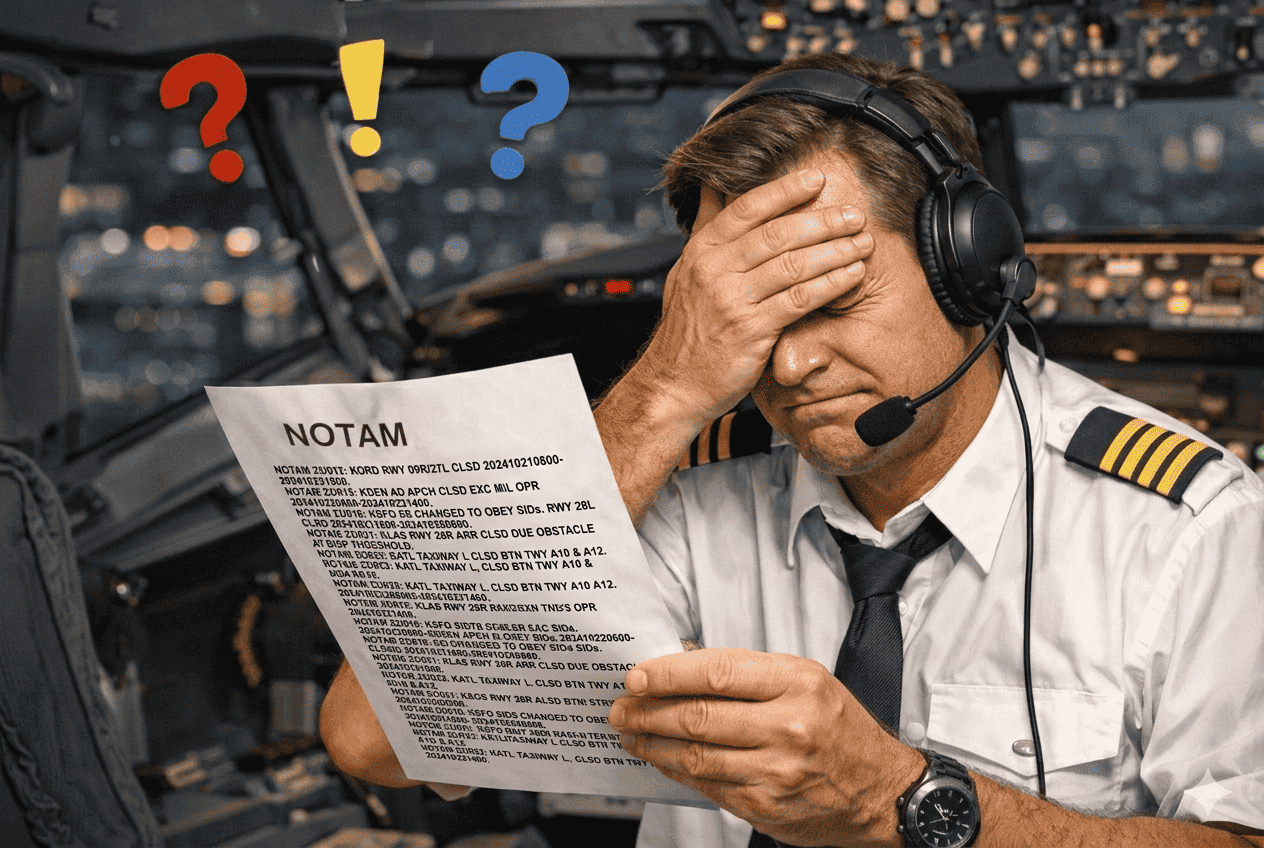
NOTAMs are critical pieces of information that can directly impact flight safety. Yet, many pilots—even experienced ones—make common mistakes when checking, reading, or interpreting NOTAMs. These errors can range from minor inconveniences to serious safety issues.
In this comprehensive guide, we'll explore the ten most common NOTAM mistakes pilots make and provide practical strategies to avoid them. Whether you're a student pilot or an experienced captain, these insights will help you develop better NOTAM checking habits and fly more safely.
⚠️ Safety First: According to ASRS (Aviation Safety Reporting System) data, NOTAM-related incidents are more common than many pilots realize. Most are preventable with proper attention to detail.
Mistake #1: Not Checking NOTAMs at All
The Error: Some pilots, particularly those flying familiar routes to airports they know well, skip NOTAM checks entirely or only give them a cursory glance.
Why It's Dangerous: Conditions at airports change constantly. A runway you've used hundreds of times could be closed for maintenance. Navigation aids can fail unexpectedly. Temporary flight restrictions can be issued with little notice. Flying without checking NOTAMs is like driving blindfolded—eventually, you'll hit something.
Real-World Example: A corporate pilot flew into a familiar airport without checking NOTAMs. Unknown to them, the main runway was closed for resurfacing, and only a shorter crosswind runway was available. The aircraft overran the runway during landing, causing significant damage. The NOTAM had been issued three days earlier.
How to Avoid It:
- Make NOTAM checking a non-negotiable part of every flight briefing
- Set up reminders on your phone before each flight
- Use apps or services that deliver NOTAMs automatically
- Treat NOTAMs with the same importance as weather briefings
- Brief NOTAMs out loud with your crew or co-pilot
Mistake #2: Only Checking Departure and Arrival Airports
The Error: Pilots check NOTAMs for their departure and destination airports but ignore en-route NOTAMs, alternate airports, and FIR NOTAMs along their route of flight.
Why It's Dangerous: En-route NOTAMs can include temporary flight restrictions (TFRs), military operations areas, navigation aid outages, and airspace closures. Missing these can lead to airspace violations, navigation errors, or encounters with unexpected traffic.
What You Should Check:
- Departure airport and all runways you might use
- Destination airport and approach procedures
- At least one alternate airport (preferably two)
- All FIRs along your route of flight
- En-route navigation aids you plan to use
- Any airports within reasonable diversion distance
- Special use airspace along your route
Pro Tip: Create a standard NOTAM checking list for each flight that includes all these elements. Don't rely on memory alone.
Mistake #3: Confusing UTC with Local Time
The Error: Misinterpreting NOTAM times, which are always in UTC (Zulu time), as local times. This is particularly common when flying across time zones or in areas where local time differs significantly from UTC.
Why It's Dangerous: Arriving at an airport when a runway is actually closed, or departing when a navigation aid is out of service, can create significant safety risks and operational problems.
Real-World Example: A pilot planned to land at 1400 local time and saw a NOTAM indicating runway closure from 1200-1600. Thinking in local time, they believed they'd arrive two hours after the closure ended. In reality, the times were UTC, and the runway would still be closed during their arrival.
How to Avoid It:
- Always convert NOTAM times to local time immediately
- Write both UTC and local times in your flight plan
- Use apps or tools that automatically show both time zones
- Double-check time conversions, especially when tired
- When in doubt, assume UTC and convert to be safe
- Keep a world clock or UTC watch visible
Mistake #4: Ignoring "Permanent" NOTAMs
The Error: Dismissing NOTAMs marked as "PERM" (permanent) because they seem like old news or thinking they'll be in published documents.
Why It's Dangerous: Permanent NOTAMs contain critical information about long-term changes that may not yet be reflected in charts or airport facility directories. These often include runway closures, navigation aid changes, or new obstacles.
What "Permanent" Really Means: A permanent NOTAM doesn't mean it's been there forever—it means the change will last until further notice. It could be weeks, months, or until the next chart publication cycle. You still need to know about it!
How to Avoid It:
- Read ALL NOTAMs, regardless of duration
- Pay special attention to PERM NOTAMs—they're often the most significant
- Don't assume permanent changes are already on your charts
- Keep a list of relevant permanent NOTAMs for frequently visited airports
- Verify chart amendments against current NOTAMs
Mistake #5: Not Understanding NOTAM Abbreviations
The Error: Skimming over unfamiliar abbreviations or making incorrect assumptions about what they mean, rather than looking them up.
Why It's Dangerous: Misunderstanding NOTAM abbreviations can lead to critical misinterpretations. "U/S" (unserviceable) is not the same as "AVBL" (available). Confusing these could mean the difference between planning for an ILS approach that isn't actually available.
Commonly Confused Abbreviations:
- CLSD vs AVBL: Closed versus Available
- U/S vs OPS NML: Unserviceable versus Operating Normally
- TEMPO vs PERM: Temporary versus Permanent
- BTN vs BEYOND: Between versus Beyond
- WIP vs WEF: Work In Progress versus With Effect From
How to Avoid It:
- Keep a NOTAM abbreviation reference card in your flight bag
- Use NOTAM Viewer's automatic parsing to see decoded information
- Look up any abbreviation you're not 100% certain about
- Never assume—when in doubt, contact the facility directly
- Quiz yourself regularly on common abbreviations
Mistake #6: Missing Schedule Restrictions (D Field)
The Error: Noting that a NOTAM is active but failing to check the D) field to see if it only applies during specific hours or days.
Why It's Dangerous: You might plan around a restriction that doesn't actually affect your flight time, or conversely, miss that a NOTAM only applies during your planned arrival window.
Real-World Scenario: A NOTAM shows runway closure from February 15-28. But the D) field states "MON-FRI 0700-1900." Flying on Saturday? The runway is actually available. Flying Monday at 1800? It's closed.
How to Avoid It:
- Always check the D) field if present
- Calculate whether the schedule overlaps with your flight times
- Remember schedules are in UTC, not local time
- Note "SR-SS" (sunrise to sunset) times vary by location and date
- When in doubt about schedule interpretation, call the facility
Mistake #7: Overlooking FDC NOTAMs
The Error: Focusing only on regular NOTAMs and ignoring Flight Data Center (FDC) NOTAMs, which are regulatory in nature.
Why It's Dangerous: FDC NOTAMs include temporary flight restrictions (TFRs), changes to instrument approach procedures, airspace amendments, and other regulatory changes. Missing these can result in airspace violations, failed approaches, or regulatory enforcement action.
What FDC NOTAMs Cover:
- Temporary Flight Restrictions (TFRs)
- Changes to instrument approach procedures
- Amendments to airspace boundaries
- Laser light operations
- Space operations
- Special security instructions
How to Avoid It:
- Always check both regular and FDC NOTAMs
- Pay special attention to TFRs along your route
- Verify approach procedure amendments before flying
- Use tools that highlight FDC NOTAMs separately
- Brief FDC NOTAMs first—they're often most critical
Mistake #8: Not Rechecking NOTAMs Before Departure
The Error: Checking NOTAMs once during flight planning (perhaps the night before) but not verifying them again closer to departure time.
Why It's Dangerous: NOTAMs can be issued at any time. A runway that was open when you checked 12 hours ago might now be closed. New TFRs can appear suddenly. Weather-related NOTAMs change with conditions.
Recommended Checking Schedule:
- Initial flight planning: Comprehensive NOTAM review
- Night before: Quick verification of major items
- Morning of flight: Full recheck before leaving home
- At airport: Final check before engine start
- If delayed: Recheck if more than 2 hours pass
How to Avoid It:
- Set multiple NOTAM check reminders
- Make final NOTAM check part of your preflight checklist
- Use mobile apps to check NOTAMs anywhere
- Subscribe to NOTAM alerts for your frequent airports
- If something changed, brief your crew immediately
Mistake #9: Ignoring Altitude Restrictions (F and G Fields)
The Error: Reading a NOTAM and assuming it applies to all altitudes, or ignoring the F) and G) fields that specify altitude limitations.
Why It's Dangerous: Many NOTAMs only apply to specific altitude ranges. Flying below or above these altitudes might mean the NOTAM doesn't affect you. Conversely, you might plan a flight level that's actually restricted.
Understanding Altitude Fields:
- F) SFC, G) 5000FT AGL: Affects surface to 5,000 feet above ground
- F) FL100, G) UNL: Affects Flight Level 100 and above (unlimited)
- F) 1000FT AMSL, G) FL180: Affects 1,000 feet MSL to 18,000 feet MSL
How to Avoid It:
- Always check F) and G) fields for en-route NOTAMs
- Plot affected altitudes on your flight planning chart
- Understand the difference between AGL, AMSL, and FL
- Consider whether you can fly above or below restrictions
- Remember that terrain elevation affects AGL calculations
Mistake #10: Failing to Brief Crew Members
The Error: Checking NOTAMs alone and not sharing critical information with other crew members, co-pilots, or even briefing it out loud for single-pilot operations.
Why It's Dangerous: In multi-crew operations, all crew members need to be aware of NOTAMs that affect the flight. For single-pilot operations, verbalizing NOTAMs helps catch misunderstandings. A second pair of eyes often catches what you missed.
Effective NOTAM Briefing:
- Highlight critical items: Runway closures, navigation aid outages, TFRs
- Discuss implications: "ILS is out, so we'll need to brief the RNAV approach"
- Verify understanding: Ask crew to acknowledge or repeat back
- Update if changes: Brief any new NOTAMs immediately
- Document: Mark critical NOTAMs on flight plan or kneeboard
How to Avoid It:
- Make NOTAM briefing a standard part of crew briefings
- Use a standardized briefing format (what, when, where, impact)
- For single-pilot ops, read critical NOTAMs out loud
- Share NOTAM links or screenshots with crew members
- Encourage crew members to review NOTAMs independently
Developing Better NOTAM Habits
Avoiding these common mistakes isn't about memorizing lists—it's about developing systematic habits that make thorough NOTAM checking automatic. Here's how to build these habits:
Create a Personal NOTAM Checklist
Develop a checklist that works for your flying:
- Check departure airport (all runways/navaids)
- Check destination airport (all approaches/procedures)
- Check alternate airports (minimum 1, preferably 2)
- Check en-route FIRs and navaids
- Check for TFRs along route
- Verify all times in UTC and local
- Note any schedule restrictions
- Check altitude restrictions
- Review FDC NOTAMs
- Brief crew on critical items
Use Technology Wisely
Modern tools like NOTAM Viewer can help you avoid mistakes by:
- Automatically parsing and color-coding NOTAM fields
- Filtering NOTAMs by keyword (RWY, ILS, TWY)
- Showing active vs. expired NOTAMs clearly
- Providing decoded abbreviations
- Enabling quick searches across multiple locations
Learn from Others' Mistakes
Read ASRS reports and accident investigations involving NOTAM-related incidents. Understanding how others made mistakes helps you avoid the same pitfalls.
The Bottom Line
NOTAM mistakes are common, but they're also preventable. Most incidents involving NOTAMs result from rushing, making assumptions, or skipping steps in the checking process. By understanding these ten common mistakes and implementing systematic checking procedures, you can significantly improve your flight safety.
Remember: NOTAMs are not optional reading. They're critical safety information designed to keep you informed about conditions that could affect your flight. Treat them with the respect they deserve, and they'll help keep you safe in the skies.
Practice Makes Perfect
The best way to avoid NOTAM mistakes is through consistent practice. Make NOTAM checking a routine part of every flight, even short local flights. Use NOTAM Viewer to practice reading and interpreting NOTAMs regularly.