
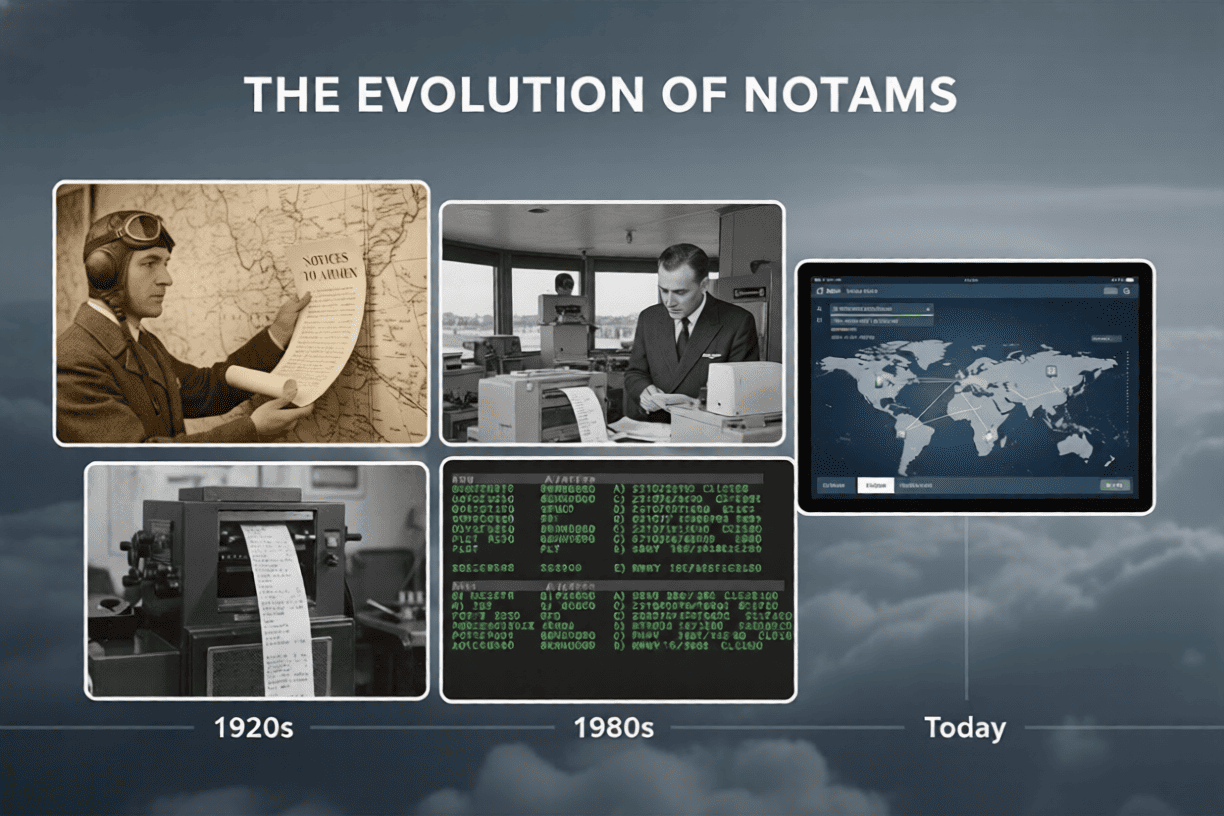
Before NOTAMs: The Early Days of Aviation Communication
December 17, 1903. The Wright Brothers achieved the first powered flight at Kitty Hawk. Their "airport" was a beach. Their "air traffic control" was a few spectators. Their "NOTAM system" was shouting to each other over the wind.
For the first two decades of aviation, flight information was communicated the same way everything else was: word of mouth, telephone calls, and letters. If you wanted to know if a field was suitable for landing, you either knew someone who'd been there or you flew over it and looked.
As aviation grew from experimental flights to airmail routes and passenger service, this informal system became dangerously inadequate. Pilots needed standardized information about airports, hazards, and changing conditions. The aviation industry needed something better.
That something would become the NOTAM system—a cornerstone of aviation safety that has evolved continuously for nearly a century.
📜 Historical Note: The term "NOTAM" first appeared in the 1920s, derived from "Notice to Airmen." By 2021, ICAO officially changed it to "Notice to Air Missions" to be more inclusive, though the acronym remained the same.
The 1920s: Birth of Formal Aviation Information
The Airmail Era
1918-1920: The U.S. Post Office begins regular airmail service. Pilots need information about:
- Landing field conditions
- Weather along routes
- Emergency landing sites
- Hazards (towers, wires, construction)
Early solutions:
- Telephone calls between stations
- Handwritten notes passed to pilots
- Local knowledge shared informally
- Trial and error (often with fatal results)
First Standardized Notices (1920s)
United Kingdom leads the way:
The British Air Ministry begins issuing standardized "Notices to Airmen" for military and civil aviation. These early NOTAMs were:
- Handwritten or typed on paper
- Distributed by post
- Sometimes delivered by telegraph for urgent information
- Posted at aerodromes on bulletin boards
Example content (1920s):
CROYDON AERODROME
15 AUGUST 1925
LARGE TENT ERECTED SOUTH SIDE OF FIELD
FOR AIR SHOW. PILOTS TO AVOID.
EFFECTIVE UNTIL 18 AUGUST.
The 1930s-1940s: International Standardization Begins
ICAO Foundation (1944)
Chicago Convention: 52 nations meet to establish international aviation standards. The Convention created ICAO (International Civil Aviation Organization) with a mission to standardize aviation practices globally.
NOTAM standardization priority: One of ICAO's first tasks was creating international standards for aviation information, including NOTAMs.
Post-War Expansion (1945-1950)
Commercial aviation boom:
- Intercontinental routes established
- Hundreds of new airports built
- Thousands of pilots needing information
- Multiple countries coordinating flights
NOTAM system challenges:
- Different countries used different formats
- Language barriers
- Time delays in distribution
- No way to ensure pilots received NOTAMs
The Telegraph Era
Primary distribution method (1930s-1960s):
Telegraph networks became the backbone of NOTAM distribution:
- NOTAMs sent by Morse code initially
- Later by teletype (TTY)
- International circuits connected major aviation centers
- Messages relayed through multiple stations
Limitations:
- Slow transmission (especially international)
- Transmission errors common
- No confirmation of receipt
- Expensive for long messages
The 1950s-1960s: The ICAO Standard Format
Annex 15 (1953)
ICAO Annex 15: "Aeronautical Information Services"
ICAO published comprehensive standards for NOTAMs including:
- Standard format and structure
- Abbreviations and contractions
- Distribution procedures
- Responsibilities of member states
The "NOTAM Code": Standardized abbreviations developed to compress information for telegraph transmission:
- RWY = Runway
- U/S = Unserviceable
- WEF = With Effect From
- HR = Hours
- And hundreds more...
Why abbreviations? Telegraph charged by the word. Shorter messages = lower cost and faster transmission.
Format Example (1960s)
LFPG PARIS CHARLES DE GAULLE
RWY 09/27 CLSD DUE WIP
1965081200-1965081600
This format—still recognizable today—would remain largely unchanged for decades.
The 1970s-1980s: Computerization Begins
Early Computer Systems
1970s breakthroughs:
Mainframe computers begin storing and retrieving NOTAMs:
- FAA develops computerized NOTAM database
- Faster searching and retrieval
- Still distributed by teletype to remote stations
- Operators manually enter NOTAMs into computer
Benefits:
- Reduced duplication
- Better organization
- Ability to search by airport, date, type
- Automatic expiration of outdated NOTAMs
Limitations:
- Expensive mainframe systems
- Only available at major facilities
- Pilots still received printed NOTAMs
- No real-time updates to remote users
The AFTN (Aeronautical Fixed Telecommunication Network)
1980s: ICAO establishes global AFTN for aviation messages including NOTAMs.
Features:
- Dedicated network for aviation (separate from public telecommunications)
- Message switching centers in each country
- Standardized message formats
- Automatic routing and delivery
- Global coverage connecting all ICAO member states
Impact: NOTAMs could now be distributed globally within minutes instead of hours or days.
The 1990s: The Internet Revolution
Online NOTAM Access
Mid-1990s transformation:
The FAA and other aviation authorities begin offering NOTAMs via the Internet:
- 1996: FAA launches public NOTAM website
- Pilots can access NOTAMs from home computers
- 24/7 availability
- No need to call Flight Service Station
Early websites:
- Text-only interfaces
- Basic search capabilities
- ASCII text output (no formatting)
- Slow dial-up connections
But revolutionary nonetheless: For the first time, pilots had direct, immediate access to NOTAMs without intermediaries.
The Q-Code System (1998)
ICAO introduces Q-line: Standardized subject coding for better filtering and processing.
Example:
Components:
- EGTT = FIR code
- QMRLC = Subject (runway lighting change)
- IV = Traffic (IFR and VFR)
- NBO = Purpose and scope
- 000/999 = Lower/upper altitude limits
- Geographic coordinates and radius
Purpose: Enable automated filtering so computers could pre-screen NOTAMs for relevance.
The 2000s: Mobile and Real-Time Access
Database Improvements
Modern databases replace mainframes:
- SQL databases for NOTAM storage
- Web-based interfaces
- Advanced search capabilities
- User-friendly display formats
- Integration with flight planning systems
Third-Party Services
Commercial NOTAM services emerge:
- ForeFlight (2007)
- Garmin Pilot
- Jeppesen FliteDeck
- Others offering enhanced NOTAM displays
Innovations:
- NOTAMs displayed on moving maps
- Color-coding by importance
- Filtering by aircraft capabilities
- Route-specific NOTAM extraction
- Push notifications for critical NOTAMs
Mobile Revolution (2007-2010)
iPhone and smartphones transform access:
- NOTAMs available on mobile devices
- Apps provide formatted, readable NOTAMs
- Access from anywhere with cellular coverage
- Integration with other flight planning data
Impact: Pilots could check NOTAMs from the ramp, during flight planning, or even in-flight (where allowed).
The 2010s: Big Data and Integration
NOTAM Overload Problem
Volume explosion:
- 1990: ~10,000 active NOTAMs globally
- 2000: ~100,000 active NOTAMs
- 2010: ~500,000 active NOTAMs
- 2020: Over 1 million active NOTAMs
Information overload becomes critical issue:
- Pilots overwhelmed by irrelevant NOTAMs
- Critical information buried in noise
- Hours spent reviewing NOTAMs for a single flight
- Safety implications of missed information
Calls for Reform
2010s studies and initiatives:
FAA studies show:
- 95% of NOTAMs irrelevant to any given flight
- Poor formatting hinders comprehension
- Abbreviations cause interpretation errors
- System needs fundamental redesign
ICAO responds:
- Working groups on NOTAM reform
- Plain language initiatives
- Digital NOTAM concept development
The 2020s: Digital Transformation
COVID-19 Impact (2020-2021)
Pandemic creates unprecedented NOTAM challenges:
- Thousands of airports closed or restricted
- Changing entry requirements by country
- Quarantine rules in NOTAMs
- Health documentation requirements
- Rapidly changing restrictions
System strained: Traditional NOTAM format inadequate for complex, rapidly-changing health regulations.
The 2023 Failure
January 11, 2023: U.S. NOTAM system fails, causing first-ever system-wide ground stop.
Wake-up call:
- Exposed system fragility
- Highlighted need for modernization
- Accelerated Digital NOTAM development
- Increased cybersecurity focus
Digital NOTAM (DIGITAM) Initiative
2020-2026: ICAO leads global transformation to Digital NOTAM
Key features:
- Machine-readable structured data
- Automated relevance filtering
- Real-time updates
- Integration with flight management systems
- Visual display on electronic charts
Early adopters (2024-2026):
- Singapore (fully operational)
- European Union (regional implementation)
- United States (testing phase)
- Australia (trials with major airlines)
Looking Forward: The Future of NOTAMs
2025-2030: Transition Period
Expected developments:
- Parallel operation of text and digital NOTAMs
- Gradual migration to DIGITAM globally
- Legacy systems phase-out planning
- Pilot training on new systems
2030-2035: Digital NOTAM Maturity
Vision:
- Global DIGITAM coverage
- Text NOTAMs deprecated
- AI-powered relevance determination
- Predictive NOTAM analytics
- Seamless integration with all aviation systems
Beyond 2035: The Next Revolution
Possibilities:
- AI Assistants: Natural language NOTAM queries ("Are there any runway closures at my destination?")
- Predictive NOTAMs: System forecasts upcoming restrictions based on patterns
- Automated Flight Planning: NOTAMs automatically adjust routes and procedures
- Augmented Reality: NOTAMs displayed in pilot's field of view via AR glasses
- Blockchain Authentication: Immutable NOTAM records preventing tampering
Lessons from 100 Years of Evolution
What's Changed
Technology:
- Handwritten notes → Telegraph → Teletype → Mainframes → Internet → Mobile → Cloud → AI
- Days to distribute → Hours → Minutes → Seconds → Real-time
- Local bulletin boards → Global digital networks
Scale:
- Dozens of airports → Tens of thousands
- Hundreds of NOTAMs → Millions
- National coordination → Global coordination
What Hasn't Changed
Core purpose: Inform pilots of conditions affecting safety
Critical importance: NOTAMs remain essential safety information
Challenge: Balancing completeness with usability
Conclusion: Continuous Evolution
From handwritten notes posted on bulletin boards to AI-powered digital systems, NOTAMs have evolved continuously for a century. Each generation of technology brought improvements, but also new challenges.
The telegraph made global distribution possible but was expensive and slow. Computers enabled searching and filtering but increased volume. The Internet provided universal access but created information overload. Digital NOTAM promises to solve current problems—and will undoubtedly create new ones for future generations to solve.
One constant remains: aviation's need for timely, accurate, actionable safety information. The technology changes, but the mission doesn't. As long as aircraft fly, some form of NOTAM will exist to warn pilots of the unexpected.
We've come a long way from telegraph operators tapping out Morse code. But in another century, pilots will look back at our current systems with the same mix of appreciation and amusement that we reserve for telegrams.
The evolution continues.
Modern NOTAM Access
While we await the full Digital NOTAM transformation, access current NOTAMs through modern, user-friendly interfaces at NOTAM Viewer.