
The NOTAM Problem
A pilot planning a transatlantic flight from New York to London receives 487 NOTAMs. Buried somewhere in those 487 text-based notices—spanning over 200 pages—is critical information: the ILS at Heathrow is out of service.
The pilot, overwhelmed by information overload, misses it. The airline dispatcher, reviewing the same 487 NOTAMs, also misses it. Only on approach, in deteriorating weather, does the crew discover the problem. They're forced to execute a less-precise approach than planned, increasing risk and workload during a critical phase of flight.
This scenario plays out daily, worldwide. The current NOTAM system—a relic of the telegram era—overwhelms users with irrelevant information while burying critical safety data in walls of text.
The solution? Digital NOTAM (DIGITAM)—a complete reimagining of how aviation safety information is created, distributed, and consumed.
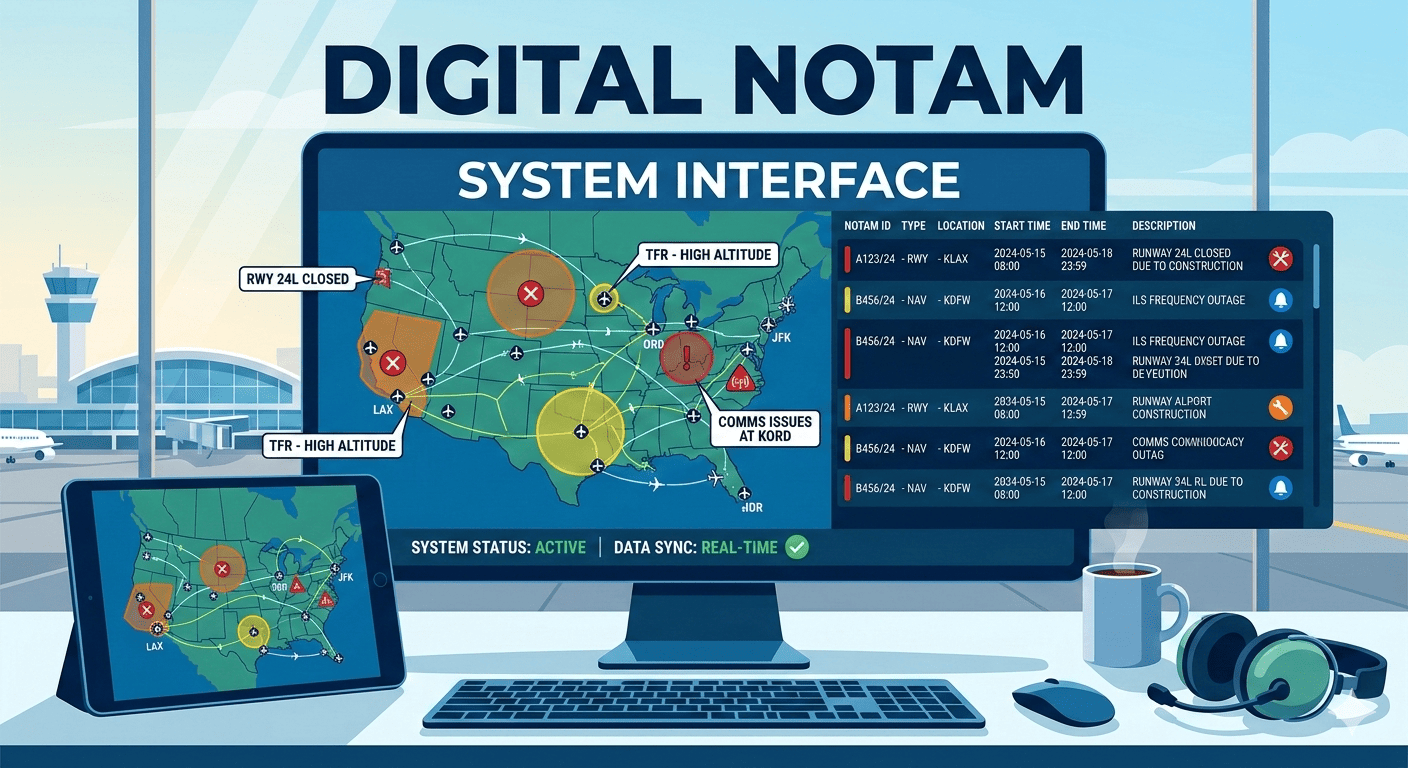
🚀 The Revolution: Digital NOTAM transforms NOTAMs from human-readable text into machine-readable structured data. Instead of 487 NOTAMs to read, pilots receive 7 relevant notices automatically filtered for their specific flight—with the critical ILS outage highlighted in red.
What's Wrong with Current NOTAMs
Information Overload
The scale of the problem:
- Over 1 million NOTAMs active globally at any time
- Average transatlantic flight: 300-500 NOTAMs
- Long-haul Asia routes: 800+ NOTAMs
- 95% irrelevant to any specific flight
Real example: A flight from Los Angeles to Singapore might receive NOTAMs about:
- Grass cutting at a small airport 200 miles off route
- Taxiway light maintenance at an airport they'll overfly at FL390
- Construction 5 years in the future
- Permanent restrictions issued 10 years ago (never cancelled)
- And buried among these: GPS interference in the South China Sea
Text-Based Format Limitations
Current NOTAM format:
2603071200-2603091600
Q) EGTT/QICAS/IV/BO/A/000/999/5128N00028W005
Problems:
- Requires decoding abbreviations (ILS, U/S, QICAS)
- Manual interpretation needed
- No automatic relevance filtering
- Difficult to prioritize
- No machine processing possible
- Errors in manual interpretation common
Human Interpretation Errors
Studies show:
- 30% of pilots misinterpret at least one NOTAM per briefing
- 15% miss critical information due to information overload
- Average pilot spends 45 minutes reviewing NOTAMs
- Still misses 5-10% of relevant information
No Standardization
Despite ICAO standards, NOTAMs vary by country:
- Different abbreviation conventions
- Varying detail levels
- Inconsistent formatting
- Multiple languages
- Regional interpretations of standards
What is Digital NOTAM (DIGITAM)?
Core Concept
Digital NOTAM transforms NOTAMs from text into structured data.
Current (Text NOTAM):
Digital NOTAM (Structured Data):
"type": "RUNWAY_CLOSURE",
"airport": "EGLL",
"runway": "09/27",
"reason": "CONSTRUCTION",
"start": "2026-03-07T12:00:00Z",
"end": "2026-03-09T16:00:00Z",
"affects": ["DEPARTURE", "ARRIVAL", "TAXI"],
"criticality": "HIGH"
}
Key Characteristics
1. Machine-Readable
- Computers can parse and process automatically
- No human interpretation needed for basic filtering
- Data can be integrated into flight planning systems
- Automatic relevance determination
2. Structured Format
- XML or JSON data structures
- Standardized fields globally
- Consistent naming conventions
- Hierarchical organization
3. Event-Based
- NOTAMs published as "events" that systems can subscribe to
- Automatic notifications of relevant changes
- Real-time updates pushed to users
- No need to poll for changes
4. Metadata-Rich
- Geographic coordinates (not just text descriptions)
- Altitude ranges in standardized format
- Criticality ratings
- Affected operations clearly specified
- Relationships to other NOTAMs
ICAO SWIM: The Foundation
What is SWIM?
SWIM = System Wide Information Management
ICAO's initiative to modernize aviation information exchange globally. Not just for NOTAMs, but all aviation data:
- NOTAMs (Digital NOTAM)
- Weather information (MET information)
- Aeronautical information (AIM)
- Flight information (FIXM)
- Surveillance data
How SWIM Works
Publish-Subscribe Model:
Traditional approach:
- Pilot/airline checks for NOTAMs manually
- Must know where to look
- Must check repeatedly for updates
- Receives all NOTAMs, filters manually
SWIM approach:
- System subscribes to relevant NOTAM types
- Automatically receives only applicable NOTAMs
- Updates pushed in real-time
- No need to poll or check manually
SWIM Architecture
Components:
- Information Providers - FAA, EUROCONTROL, national CAAs publish data
- SWIM Infrastructure - Network that connects providers and consumers
- Information Consumers - Airlines, pilots, dispatchers, FMS systems receive data
- Registry - Catalog of available information and how to access it
Benefits:
- Single source of truth for aviation data
- Real-time information sharing
- Reduced duplication
- Improved data quality
- Faster information dissemination
The Pilot Experience: Before and After
Current System (Text NOTAMs)
Pre-flight planning:
- Access FAA or national NOTAM website
- Enter departure, destination, route
- Receive 300-500 NOTAMs (50+ pages)
- Read through all NOTAMs (45 minutes)
- Manually identify relevant ones (hoping not to miss any)
- Cross-reference with charts and plates
- Make notes of critical items
- Brief crew verbally on key points
Result: Time-consuming, error-prone, overwhelming
Digital NOTAM System
Pre-flight planning:
- Open flight planning app (integrated DIGITAM)
- Enter flight details (aircraft type, departure, destination, route, altitude)
- System automatically retrieves and filters NOTAMs
- Receive 7 relevant NOTAMs with priority rankings:
- 🔴 CRITICAL: ILS RWY 27L out of service
- 🟠 HIGH: Taxiway B closed, affects departure routing
- 🟡 MEDIUM: Frequency change for ground control
- 🟢 LOW: Construction 500ft off taxiway (no operational impact)
- Review critical items (5 minutes)
- One-click crew briefing generation
- Automatic FMS integration (relevant NOTAMs loaded to aircraft systems)
- In-flight updates pushed automatically if NOTAMs change
Result: Fast, accurate, comprehensive, automated
Visual Display Examples
Map integration:
- NOTAMs displayed directly on moving map
- Runway closures shown on airport diagram
- Airspace restrictions highlighted on chart
- GPS interference areas shaded
- Color-coded by priority
Timeline view:
- NOTAMs organized by when they affect the flight
- Pre-departure items grouped
- En-route restrictions by time/location
- Arrival-specific NOTAMs highlighted
Benefits for Aviation Stakeholders
For Pilots
Safety improvements:
- Critical information can't be buried
- Automatic prioritization
- No more missing relevant NOTAMs
- Visual presentation reduces interpretation errors
Efficiency gains:
- NOTAM review: 45 minutes → 5 minutes
- No manual filtering needed
- Integrated with flight planning (no separate systems)
- Real-time updates automatically received
For Airlines and Operators
Cost savings:
- Reduced dispatcher workload (automation handles filtering)
- Fewer delays from missed NOTAMs
- Better fuel planning (accurate NOTAM info on routing)
- Reduced diversions (real-time updates prevent surprises)
Estimated savings per airline:
- Major airline: $5-10 million annually
- Regional carrier: $500,000 - $1 million annually
Operational improvements:
- Automated dispatch procedures
- Better crew briefings
- Improved safety margins
- Data analytics on NOTAM trends
For Air Traffic Control
- Better situational awareness (know what pilots know)
- Automatic coordination with pilots on NOTAM info
- Reduced workload (fewer questions about NOTAMs)
- Integration with ATC systems
For Regulators and Authorities
- Better data quality control
- Analytics on NOTAM usage and effectiveness
- Improved safety oversight
- Easier international coordination
- Reduced NOTAM spam (validation catches errors)
Implementation Timeline
Phase 1: Development (2020-2025)
Completed:
- ICAO standards finalization
- DIGITAM data model specification
- SWIM architecture design
- Proof-of-concept implementations
- Early adopter trials
Phase 2: Early Adoption (2025-2028)
In progress:
- Leading countries implement DIGITAM systems
- Major airlines begin integration
- Parallel operation with text NOTAMs
- Training programs developed
- System refinement based on real-world use
Current leaders (2026):
- Singapore: Fully operational DIGITAM system
- European Union: EUROCONTROL leading regional implementation
- United States: FAA SWIM operational, DIGITAM in testing
- Australia: Advanced trials with Qantas
- UAE: Dubai implementing for Emirates operations
Phase 3: Global Rollout (2028-2032)
Planned:
- Regional implementation across continents
- Interoperability testing between systems
- Legacy system phase-out planning
- Training scaled to all users
- Regulatory updates
Phase 4: Full Operation (2032-2035)
Target:
- Global DIGITAM coverage
- Text NOTAMs deprecated
- All major airlines integrated
- FMS systems natively support DIGITAM
- Continuous improvement and enhancement
Technical Architecture
Data Format
AIXM (Aeronautical Information Exchange Model)
- XML-based data standard
- Developed and maintained by EUROCONTROL and FAA
- Covers all aeronautical information (not just NOTAMs)
- Version 5.1 current standard
Event Model:
- Each NOTAM is an "Event" object
- Events have defined lifecycles (created, updated, cancelled)
- Events reference aeronautical features (runways, navaids, airspace)
- Relationships between events can be expressed
Distribution Methods
1. Publish-Subscribe (Primary)
- Systems subscribe to NOTAM types of interest
- Updates pushed automatically
- No polling required
- Efficient bandwidth usage
2. RESTful APIs (Supplementary)
- HTTP-based data retrieval
- Query by airport, route, area, type
- JSON response format
- Useful for ad-hoc queries
3. Message Queues
- AMQP (Advanced Message Queuing Protocol)
- Guaranteed delivery
- High reliability
- Scale to thousands of consumers
Security and Authentication
- Digital signatures on all NOTAMs (prevents tampering)
- Certificate-based authentication
- Encrypted data transmission (TLS 1.3)
- Access control and authorization
- Audit logging
Challenges and Obstacles
Technical Challenges
Legacy system integration:
- Thousands of existing systems worldwide
- Many incapable of processing structured data
- Expensive to upgrade or replace
- Transition period complexity
Data quality:
- Garbage in, garbage out problem
- Current NOTAMs have many errors
- Automated systems will propagate errors faster
- Requires improved validation at creation
Backwards compatibility:
- Must support both text and digital NOTAMs during transition
- Synchronization between formats challenging
- Risk of inconsistencies
Organizational Challenges
International coordination:
- 190+ countries must agree on standards
- Different implementation timelines
- Varying technical capabilities
- Political considerations
Training requirements:
- Millions of aviation professionals worldwide
- New procedures and workflows
- Change management complexity
- Ongoing training needs
Financial Challenges
Implementation costs:
- Government systems: $50-200 million per country
- Airline integration: $1-5 million per major airline
- Global total estimate: $5-10 billion
Funding questions:
- Who pays for infrastructure?
- Cost recovery models
- Developing country support
The Road Ahead
Beyond DIGITAM: Future Enhancements
AI-Powered Intelligence:
- Predictive analytics (forecast NOTAM impacts)
- Intelligent prioritization (learn user preferences)
- Natural language summaries (convert data back to readable form)
- Anomaly detection (catch unusual or erroneous NOTAMs)
Direct FMS Integration:
- NOTAMs automatically update flight plan
- Route changes suggested automatically
- Performance calculations adjusted for NOTAMs
- Approach selection based on NOTAM data
Collaborative Decision Making:
- NOTAMs shared between stakeholders in real-time
- Airlines coordinate responses to major NOTAMs
- ATC and airlines jointly manage NOTAM impacts
What Pilots Can Expect
Near term (2026-2028):
- Parallel systems (both text and digital NOTAMs available)
- Early adopter airlines offer DIGITAM in flight planning
- Mobile apps begin supporting DIGITAM
- Training on new systems begins
Medium term (2028-2032):
- Most major routes covered by DIGITAM
- Text NOTAMs becoming secondary
- New aircraft delivered with native DIGITAM support
- Significant workflow improvements realized
Long term (2032+):
- Global DIGITAM coverage
- Text NOTAMs phased out
- NOTAMs fully integrated into all aviation systems
- Continuous AI-driven improvements
Conclusion: A Necessary Evolution
The current NOTAM system was revolutionary—in 1947. Telegram-based text notices were cutting-edge technology for global aviation communication. But we've been using essentially the same system for nearly 80 years while aviation has transformed completely.
Modern aircraft navigate by GPS to within meters. Flight management systems compute optimal routes in seconds. Airlines manage fleets of hundreds of aircraft in real-time. Yet pilots still wade through hundreds of pages of text NOTAMs using methods that haven't fundamentally changed since before jet aircraft existed.
Digital NOTAM isn't just an improvement—it's a necessary evolution to match the sophistication of every other aviation system. It will save time, reduce errors, improve safety, and finally bring NOTAM systems into the 21st century.
The transformation won't be easy. It will take years, cost billions, and require unprecedented international coordination. But the alternative—continuing with a system that overwhelms users and buries critical safety information—is no longer acceptable.
The future of NOTAMs is digital. And that future is already beginning.
Experience Modern NOTAM Access
While the industry transitions to full Digital NOTAM, NOTAM Viewer provides fast, filtered access to current NOTAMs worldwide.