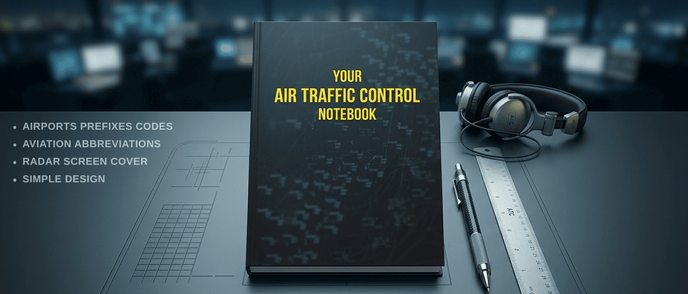

In the demanding world of air traffic control, having the right tools can make all the difference between efficient operations and missed details. While digital systems dominate modern ATC facilities, a well-designed physical notebook remains an indispensable companion for controllers, students, pilots, and aviation enthusiasts. Today, we're reviewing a specialized ATC notebook that's become a favorite among aviation professionals worldwide.
Why Air Traffic Controllers Need a Dedicated Notebook
Air traffic control is a profession where split-second decisions affect hundreds of lives. Despite advanced digital systems, experienced controllers know that a physical notebook serves critical functions:
- Quick Reference: Instant access to critical codes and abbreviations without system lookups
- Shift Notes: Documenting unusual events, frequency changes, or special procedures
- Training Records: Students tracking certifications, endorsements, and learning progress
- Incident Documentation: Recording details of pilot deviations, emergencies, or unusual situations
- Professional Development: Logging training hours, facility changes, or career milestones
- Backup System: When digital systems fail, paper never crashes
Overview: The ATC Professional Notebook
This specialized notebook is designed specifically for the aviation community—air traffic controllers, ATC students, pilots, and aviation enthusiasts. Unlike generic notebooks, it comes packed with features that reflect the real needs of aviation professionals.
Key Features
✈️ ICAO Airport Prefix Codes
The notebook includes comprehensive ICAO airport prefix codes—an essential reference for controllers working with international traffic. Instead of searching through databases or waiting for system queries, you have instant access to airport identifiers organized by region. Perfect for quick coordination with adjacent facilities or verifying flight plans.
📝 Aviation Abbreviations Reference
Aviation is filled with acronyms and abbreviations—from basic phraseology to complex equipment codes. The included abbreviations reference covers everything from common ATC terminology to aircraft equipment suffixes, ensuring you're never stuck trying to decode unfamiliar shorthand during busy periods.
📡 Radar Screen Cover Design
The notebook features a distinctive radar screen cover design that immediately identifies it as an aviation professional's tool. The clean, professional appearance fits perfectly in control towers, TRACON facilities, or flight planning rooms, while the durable cover protects your notes during daily use.
🎨 Simple, Functional Design
Simplicity is the hallmark of good design. This notebook avoids unnecessary clutter, focusing instead on functionality. Clean pages, clear layout, and practical organization mean you spend less time navigating the notebook and more time using it effectively during operations.
Who Should Use This Notebook?
Air Traffic Controllers
Tower Controllers: Document visual separation techniques, unusual weather events, runway configuration changes, or coordination with ground control. Track aircraft performance observations, pilot requests, and facility-specific procedures.
TRACON Controllers: Log complex arrival/departure sequences, hold instructions, frequency congestion issues, or unusual flight plan routings. Record coordination points with adjacent facilities and document vectoring techniques for different aircraft types.
En-Route Controllers: Track oceanic clearances, altitude requests, international coordination, or weather deviation procedures. Document handoff procedures with adjacent centers and special event operations.
ATC Students
For students in ATC training programs, this notebook becomes an essential learning companion:
- Track certification progress through different positions (ground, tower, departure, approach)
- Document training scenarios and instructor feedback
- Log simulation hours and real-world observation time
- Record common mistakes and lessons learned
- Quick reference for ICAO codes during training exercises
- Study aid for abbreviations and phraseology exams
Pilots
Professional and student pilots can use this notebook for:
- Flight planning notes and airport information
- ICAO code reference for international operations
- Weather briefing documentation
- ATC clearance backup (write down complex clearances)
- Training flight debriefs and lessons learned
- Cross-country planning and airport research
Aviation Enthusiasts
Even if you're not working in aviation professionally, this notebook serves aviation enthusiasts well:
- Spotting logs at airports (aircraft types, registrations, routes)
- Air show notes and observations
- Flight tracking documentation
- Aviation radio monitoring logs
- Learning resource for understanding ATC operations
- Travel journal for aviation-themed trips
Practical Use Cases in Daily Operations
Shift Documentation
Controllers can use the notebook to maintain a shift log documenting:
- Start/End Times: Exact position relief times and breaks
- Traffic Volume: Approximate aircraft handled during shift
- Notable Events: Go-arounds, missed approaches, emergency declarations
- Frequency Issues: Radio problems, stuck microphones, interference
- Weather Changes: Significant weather that affected operations
- Coordination Notes: Special arrangements with adjacent facilities
Incident Recording
When unusual situations occur, having contemporaneous notes is invaluable:
Date: 15 MAR 2025
Time: 1437Z
Position: Tower Local Control
Event: Runway incursion - Vehicle crossed RWY 27 without clearance
Action: Issued go-around to DAL123 on 2-mile final
Traffic: Light, VFR conditions
Supervisor: Notified immediately, incident report filed
Notes: Vehicle was airport maintenance, coordination breakdown with ground control
Training Progress Tracking
ATC students can create a structured training log:
- Date and facility/position trained
- Instructor name and rating
- Scenarios practiced
- Skills demonstrated successfully
- Areas needing improvement
- Hours logged toward certification
Why Physical Notebooks Still Matter in Digital ATC
Modern air traffic control facilities are equipped with advanced digital systems—radar displays, flight data processing, electronic flight strips, and automated coordination. So why do experienced controllers still carry physical notebooks?
Reliability
Digital systems can fail. Power outages, software crashes, network issues—all have occurred in ATC facilities. A notebook never loses battery, never crashes, and always boots instantly. During system failures or backup procedures, your paper notes become critical.
Speed
Flipping to a reference page in a notebook is often faster than navigating through digital menus, especially during high-workload situations. When you need an ICAO code or abbreviation quickly, physical reference beats digital search.
Legal Documentation
Handwritten, contemporaneous notes carry significant weight in legal proceedings and investigations. They demonstrate your real-time thinking and decision-making process in ways that after-the-fact digital entries cannot replicate.
Personal Learning
Research shows that handwriting notes improves retention and understanding compared to typing. For students learning complex ATC procedures, physically writing reinforces learning more effectively than digital note-taking.
How to Maximize Your ATC Notebook
Organization Tips
Date Everything: Every entry should have a date and time. For shift notes, include UTC time to maintain consistency with ATC operations.
Use Clear Headers: Organize entries with clear section headers—Shift Log, Training, Incidents, Frequencies, Procedures, etc.
Create an Index: Use the first or last few pages as an index, noting page numbers for important entries so you can find them quickly later.
Color Coding: Consider using different colored pens for different types of entries— black for normal operations, red for incidents, blue for training, etc.
What to Document
Normal Operations: Don't just record problems. Document successful techniques, efficient traffic flows, and positive coordination examples. These become reference points for future operations.
Learning Moments: When you see an experienced controller handle a situation brilliantly, write it down. When you make a mistake, document it and what you learned.
Facility-Specific Procedures: Every facility has unique procedures, LOAs (Letters of Agreement), and coordination points. Document these as you learn them.
Professional Development
Use your notebook to track career progression:
- Certification dates for different positions
- Facility transfers and qualifications
- Training completed (refresher courses, emergency procedures)
- Professional achievements and commendations
- Goals for advancement (supervisor, trainer, different facility)
Comparing to Digital Note-Taking Apps
Some controllers use digital note-taking apps on tablets or phones. How does a physical notebook compare?
Advantages of Physical Notebooks
- No security concerns (many ATC facilities restrict personal electronic devices)
- No battery limitations
- Faster access during busy periods
- Legal admissibility (handwritten notes often carry more weight)
- No distractions (notifications, other apps)
- Works in any environment (no screen glare issues)
When Digital Makes Sense
Digital tools excel at:
- Searchability (finding specific entries across months of notes)
- Backup and sync (cloud storage prevents loss)
- Sharing (sending notes to supervisors or investigators)
- Integration (linking to other systems or documents)
Many controllers find a hybrid approach works best—physical notebook for daily operations and critical documentation, with occasional digital backup of important entries.
Caring for Your ATC Notebook
Durability
ATC facilities can be demanding environments. Protect your notebook by:
- Storing it in a designated spot at your position
- Using a protective cover if working in harsh conditions
- Keeping pens attached (nothing worse than losing your pen mid-shift)
- Avoiding food and drink near your notebook
Retention
How long should you keep ATC notebooks? Consider:
- Active Notebook: Current notebook in daily use
- Recent (1-2 years): Keep accessible for reference and potential investigations
- Archive (2-5 years): Store securely; incidents can be investigated years later
- Historical (5+ years): Consider digitizing and disposing, or keep for career records
Beyond the Basics: Advanced Uses
Custom Reference Sections
Experienced controllers often customize their notebooks with additional reference material:
- Local frequency charts
- Common routing abbreviations
- Military aircraft identifiers
- Emergency procedure quick references
- Phonetic alphabet (for new controllers)
- Unit conversion tables (feet/meters, nautical miles/statute miles)
Facility-Specific Information
Document your specific facility's unique characteristics:
- Runway configurations and when they're used
- Local traffic patterns and special procedures
- Adjacent facility coordination procedures
- Military operation coordination
- Special event procedures (air shows, VIP movements)
The Bottom Line: Is This Notebook Worth It?
For air traffic controllers, students, pilots, and aviation enthusiasts, this specialized notebook offers genuine value beyond a generic journal:
✅ Pros
- Aviation-specific reference material (ICAO codes, abbreviations)
- Professional radar screen design
- Clean, functional layout for operations
- Affordable price point
- Immediately useful without customization
- Perfect for training environments
⚠️ Considerations
- Physical notebooks require manual backup if notes are critical
- Limited to printed reference material (can't update ICAO codes as they change)
- May need additional customization for specific facility procedures
Who Benefits Most
Essential for:
- ATC students in training programs
- Controllers new to international coordination
- Pilots planning international flights
- Aviation enthusiasts learning ATC operations
Very useful for:
- Experienced controllers wanting organized documentation
- Controllers transitioning between facilities
- Training instructors teaching new controllers
- Pilots flying to unfamiliar airports
Alternatives and Comparisons
While generic notebooks can work, this specialized ATC notebook offers immediate value through its built-in reference materials. Alternatives include:
Generic Professional Notebooks: Cheaper but lack aviation-specific references. You'd need to manually create ICAO code lists and abbreviation tables.
Custom-Made Notebooks: Some controllers create their own with binders and printed references. More flexible but more work to set up.
Digital Solutions: Apps and tablets offer searchability but face restrictions in many ATC facilities and lack the legal weight of handwritten notes.
Final Thoughts: A Worthwhile Investment
In a profession where decisions happen in seconds and the stakes are measured in lives, having reliable tools matters. This ATC notebook strikes an excellent balance between specialized functionality and practical usability.
The ICAO codes reference alone saves countless interruptions during operations. The aviation abbreviations help students learn the language of ATC faster. The professional appearance fits the serious nature of the work. And the simple design means you focus on content, not navigating a complicated notebook system.
Whether you're a student controller working toward your first certification, an experienced professional maintaining detailed operational records, a pilot planning complex international routes, or an aviation enthusiast deepening your understanding of air traffic control—this notebook deserves a place in your professional toolkit.
At its modest price point, it's an investment that pays dividends in organization, efficiency, and professional development. Your future self—reviewing notes during an investigation, preparing for certification, or simply remembering a brilliant technique you documented months ago—will thank you for maintaining detailed records in a purpose-built tool.
📖 Get Your ATC Professional Notebook
✈️ ICAO Airport Codes Reference
📝 Aviation Abbreviations Guide
📡 Professional Radar Screen Cover
🎨 Clean, Functional Design
Perfect for controllers, students, pilots, and aviation enthusiasts
Disclaimer: This review is based on the product features and typical use cases in air traffic control operations. Individual experiences may vary. Always follow your facility's policies regarding personal notebooks and documentation requirements.